Low Temperature Geothermal Energy: an indispensable link in the heat transition
The Dutch energy transition is often about sun and wind, but almost half of our energy needs consist of heat. If you want to achieve the climate goals, you should therefore accelerate there in particular. Low Temperature Geothermal Energy (LTA) is thus developing into a promising and increasingly concrete solution.
At a well-attended meeting of Geothermal Netherlands on February 12, 2026 in Utrecht, it became clear again that interest in this form of sustainable heat is growing strongly. Governments, market parties and knowledge institutions are working together on the further development and application of low-temperature geothermal energy in the Netherlands.
For Gaia Energy, this is an important development: LTA offers opportunities for reliable, local and future-proof heat supply.
What does Low Temperature Geothermal Energy mean?
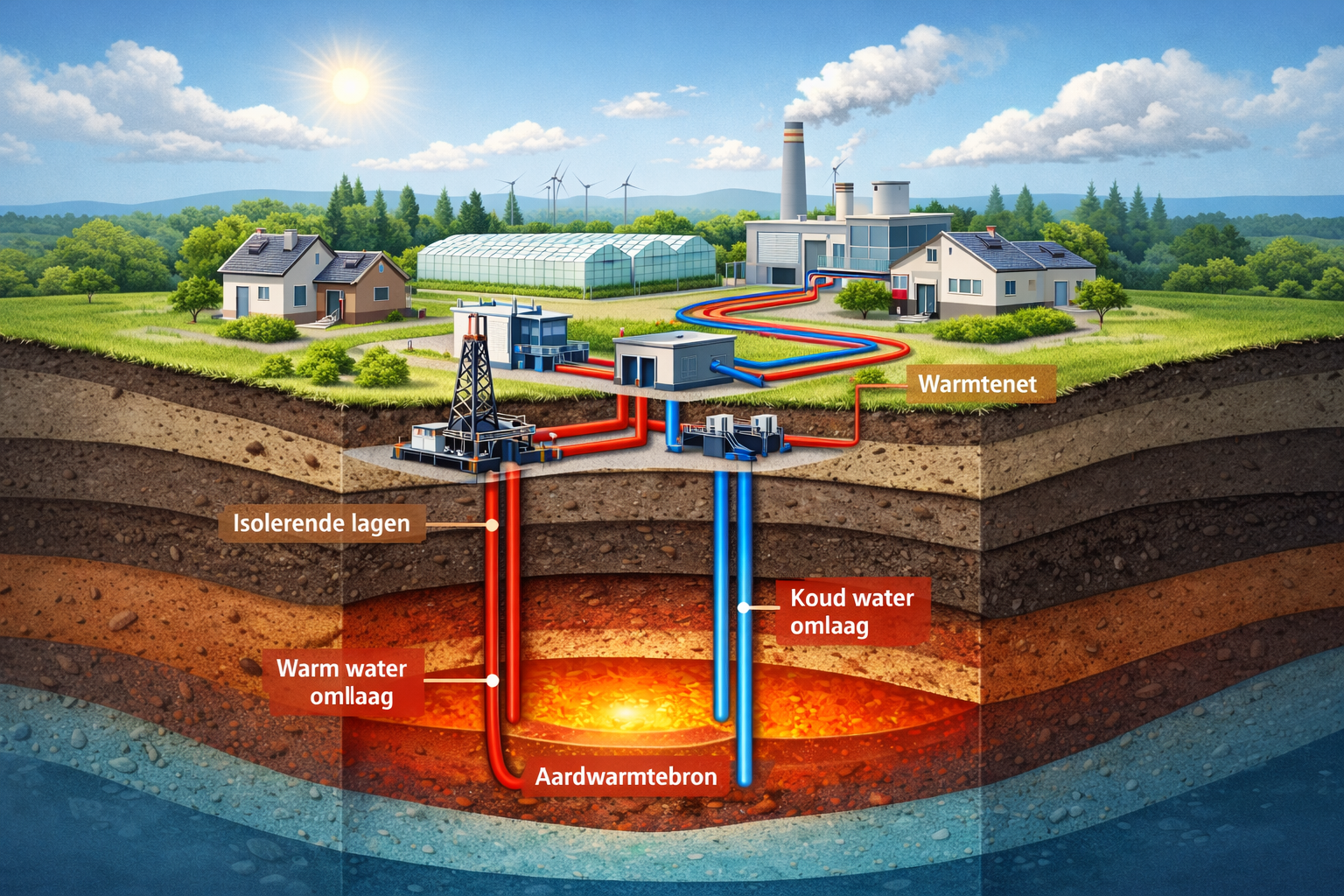
Low Temperature Geothermal energy is the extraction of heat from the shallow to medium-deep subsoil, usually up to a depth of around 1,500 meters. The resulting temperatures are lower than traditional (high temperature) geothermal energy, but very suitable for:
- heating homes and utility buildings,
- supply to low and medium temperature heat networks,
- applications in horticulture,
- combination with heat pumps in hybrid systems.
Because the heat source is relatively close to use, LTA is particularly suitable for area-specific solutions. Think of residential areas, industrial parks or greenhouse clusters where sustainable heat is generated and used locally.
In contrast to the sun and wind, geothermal energy is also available continuously. It is a stable, weather-independent energy source that can provide heat day and night.
Why is LTA so important?
Making heat more sustainable is one of the biggest challenges in the energy transition. A large part of the built environment is still dependent on natural gas. Alternatives such as heat pumps and residual heat play an important role, but are not sufficient or optimal for use everywhere.
Low-temperature geothermal energy can:
- structurally reduce dependence on natural gas;
- contributing to affordable and predictable energy costs;
- strengthening local energy supply;
- making large-scale CO₂ reduction possible;
- making heat networks more sustainable with a stable basic source.
It is precisely in combination with heat networks that a powerful system is created. LTA can serve as a sustainable base load, while other sources and techniques absorb peaks. This creates a robust and future-proof heat infrastructure.
Developments: from potential to practice
Although low-temperature geothermal energy has a lot of potential, market development is still relatively early. Projects are often new, and there are uncertainties about surface data, technical risks and early phase funding.
In order to lower these thresholds, the following will be used in the coming years:
- better insight into the subsoil, especially in so-called data-poor areas;
- supporting example projects;
- innovation and cost reduction;
- structural knowledge sharing within the sector.
For this purpose, around 90 million euros have been made available from the Climate Fund for the period 2025—2029. A subsidy scheme for concrete scale-up projects (SOLTA) is also being worked on, which can accelerate the realization of exemplary projects.
The goal is clear: projects need to be developed faster, more predictably and cost-efficiently, so that low-temperature geothermal heat has a full position within the Dutch heating system.
Building sustainable heat together
The broad interest from the government, the market and knowledge institutions shows that low-temperature geothermal energy is being taken seriously as part of the heat transition. Not as a replacement for other solutions, but as a supplement that makes the energy system stronger and more flexible.
For Gaia Energy, this development is part of the broader vision of sustainable, area-based energy systems. By cleverly combining geothermal energy with heat networks, heat pumps and other renewable sources, a stable and scalable alternative to natural gas is created.
The coming years will be decisive. With more knowledge, practical experience and cooperation, low-temperature geothermal energy can become a fixed pillar of the sustainable heat supply in the Netherlands.